Research highlights how much grades kill intrinsic motivation and the pursuit of learning and knowledge. It's time to kill grades.
Link copied to clipboard!
Every year, millions of students receive grades that reportedly measure their learning. And every year, these same grades fail spectacularly at their intended purpose while actively killing learning.
Despite plenty of research about the ill effects of traditional grading, we cling to this system with remarkable stubbornness.
Why?
Mainly because grades are easy to give out and easy to understand. Or at least they seem to be.
An A means excellent, an F means failing.
What could be simpler?
But this simplicity is precisely the problem. Learning isn’t simple, and pretending it is creates more harm than we realize.
The industrial hangover
Our grading system is a relic of the industrial age, designed when schools needed to process large numbers of students efficiently. Letter grades provided standardization and scalability. They’re the educational equivalent of the assembly line.
While this made sense for mass education in an industrial economy, it’s strikingly misaligned with today’s needs for creativity, critical thinking, and collaboration.
Consider two fundamental problems with what we’ve inherited:
Grading systems treat academic success as a limited resource where only some students can excel, when in fact learning and understanding don’t need to be restricted this way
They reduce complex learning into oversimplified numbers that hide more than they reveal
The motivation murderer
Research consistently shows that grading undermines intrinsic motivation and learning quality. Multiple studies by Deci and Ryan demonstrate that external rewards, including grades, reliably decrease students’ interest in learning for its own sake.
Butler’s research found that students who received only comments on their work showed more improvement and engagement than those who received either grades alone or grades with comments.
This plays out in predictable ways:
Students choose easier tasks to ensure better grades
They avoid intellectual risks
They focus on what will be tested rather than true understanding and what interests them
They compete rather than collaborate
The evidence is overwhelming. Educational psychologists have found that when students focus on grades:
Their creativity diminishes
Their preference for challenging tasks decreases
Their interest in the subject matter declines
Their quality of thinking deteriorates
“Is this on the test?” syndrome
Walk into any classroom today and you’ll hear the same questions:
Of course, you can’t blame students. Like all people and organizations, they respond to incentives. If we keep telling them grades matter, they’ll do everything in their power to win that game.
Research by Black & Wiliam shows that when students are focused on grades, they’re less likely to:
Ask deep, conceptual questions
Explore topics beyond the curriculum
Take on challenging material
Engage in creative problem-solving
The cumulative deficit trap
Perhaps the most insidious effect of grades is how they create and amplify learning gaps.
Here’s a simple example:
A student learns multiplication but doesn’t fully grasp how multiplication works.
They memorize enough for the test and get 80% overall.
The class moves on to area calculations.
Now they’re trying to find the area of a 7 by 8 rectangle while still shaky on the underlying multiplication.
They manage 70% through memorization of recipes (formulas) and test-taking strategies.
Then comes the topic of volume.
Each topic builds on increasingly unstable foundations.
Perhaps just as bad, students begin to negatively label themselves and close themselves off from critical numeracy and literacy skills, i.e. “I’m not a math person” or “I don’t like books”.
Instead of actually learning, they are now just fighting for academic survival.
The grade disguises the gap while simultaneously ensuring it grows larger.
The real world disconnect
The grading system doesn’t just fail in an academic setting.
It also fails to prepare students for actual workplace challenges in several critical ways:
Real World Reality vs. Grading System:
Collaboration is essential. Grades promote competition.
Research by Gardner and others shows that the skills most valued by employers, i.e,, creativity, adaptability, collaboration, and problem-solving, are precisely the ones diminished by traditional grading systems.
A conversation with entrepreneurial force Gary Vaynerchuk from My First Million (video below) highlights the disconnect beautifully.
Vaynerchuk is a master communicator yet his high school grades reveal the following:
D in Speech
D in English
F in German
D in Algebra
A in Physical Education
About his grades, Vaynerchuk says:
A lot of data in the world is dirty. It’s fake. Grades are not a tremendous indicator of what is going to happen.
Studies of grade-free schools show their graduates are often more motivated, more creative, and better prepared for college than their traditionally-graded peers.
Grade inflation: The final absurdity
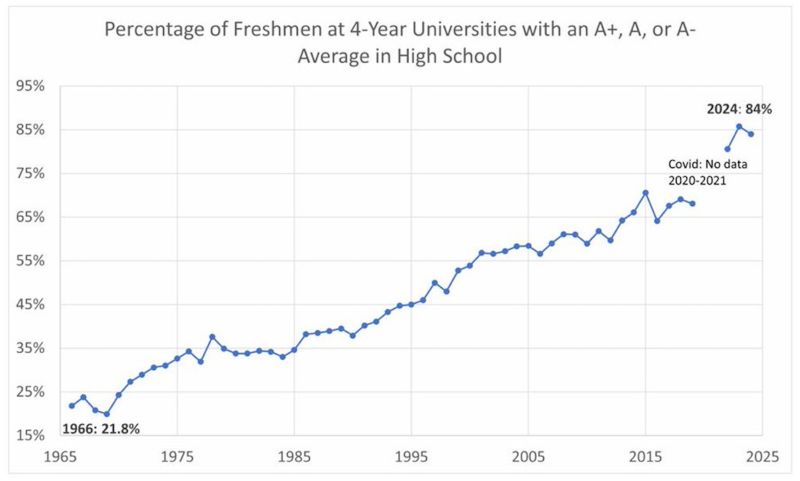
Even as grades fail at their intended purpose, they’ve become increasingly meaningless through inflation.
84% of high school grads now attending a 4 yr college had an A or A- average at graduation. As we talk to college admissions officers, they acknowledge this and highlight that “proof of capability” demonstrated beyond grades is more important than ever.
source: UCLA Higher Education Research Institute (HERI), CIRP Freshman Survey
Moving forward
The solution isn’t to tweak the grading system but to fundamentally rethink assessment.
Some promising alternatives include:
Mastery-based transcripts & progression
Portfolio assessment
Narrative evaluation
Student self-assessment
Qualitative feedback systems
At Forge Prep, we use the Proof Transcript to measure progress, not perfection.
For now, we need to acknowledge that our grading system isn’t just imperfect. It’s actively harmful to student learning. We’re using a system that demonstrably reduces creativity, dampens motivation, promotes shallow learning, and fails to prepare students for real-world challenges thus weakening our collective future.
We should move swiftly to replace them with approaches that respect learners’ curiosity and potential.
Adopting them will require reevaluating entrenched habits and accepting that efficiency at the expense of true understanding is not a good trade. The reality is that grades have served their purpose and run their course. It’s time to build a new system. A system that prioritizes mastery over marks, skills over scores and progress over perfection.
About Us
Forge Prep is reimagining education for grades 5-12. We equip students to be explorers, builders, and leaders. Our students learn by doing: starting, running, and even acquiring real businesses while developing critical thinking, resilience, and leadership skills. Our mission is simple: build a generation of remarkable students who solve problems and shape the future.