Proof Over Perfection: What Should Replace Your Child’s Report Card
Proof Over Perfection: What Should Replace Your Child's Report Card
Report cards were designed in 1912. Your child will graduate into a world that demands proof of capability, not letters on paper. The Proof Transcript gives them exactly that.
Your child brings home a report card.
You see “B+” in Math. What does that mean?
- Did they master algebraic reasoning but struggle with geometry?
- Are they working two grade levels ahead in some areas?
- Can they apply mathematical thinking to real problems, or just execute procedures on worksheets?
You have no idea.
The B+ obscures more than it reveals.
Now imagine opening your phone and seeing this instead:
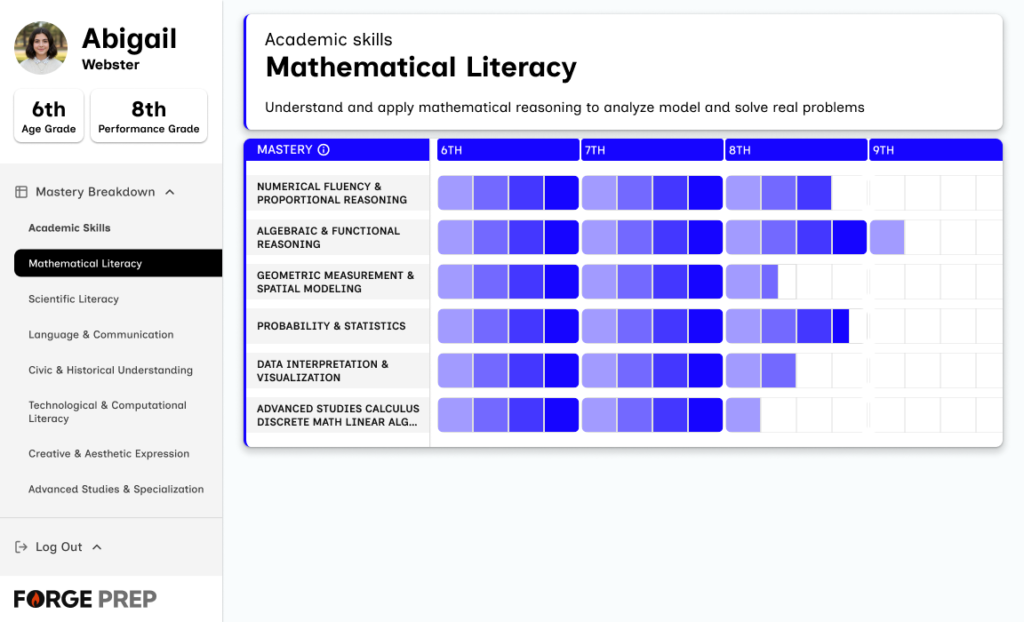
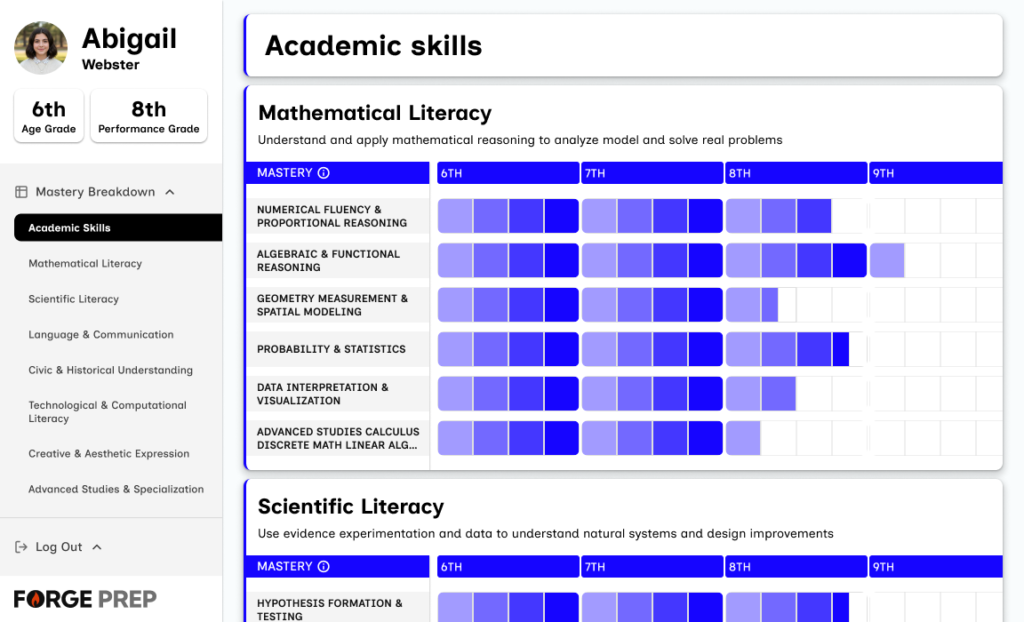
- Your daughter is working at 9th grade level in Algebraic & Functional Reasoning.
- She’s in 8th grade.
- Click “Evidence of Mastery” and you see her Diabetes Campaign project: a working calculator she built using proportional relationships to show how serving sizes affect blood sugar, complete with graphed linear relationships and equations for planning campaign budgets.
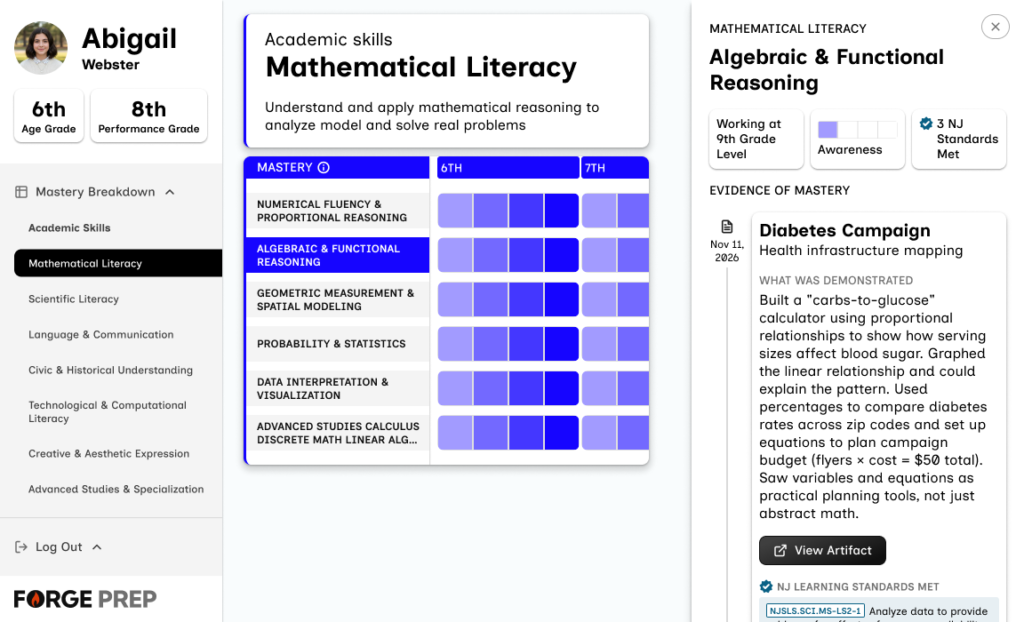
You know exactly what she has done and can do.
You can see the actual work.
You understand what comes next.
This is what measuring progress looks like. Not chasing perfection.
This is Forge Prep’s Proof Transcript. One living record that does two jobs: it replaces quarterly report cards AND the final transcript colleges eventually see.
Why combine them?
Because learning doesn’t happen in quarterly snapshots. The Proof Transcript tracks progress from day one through graduation. Parents access real-time updates online. When colleges need it, we print the complete record. No translation needed. No signal lost.
The Proof Transcript operates on one core principle: progress over perfection. Students aren’t penalized for not knowing something yet. They’re celebrated for demonstrating mastery when they’re ready.
This changes everything about how students approach learning. Instead of doing the bare minimum to get the grade, they push as far and fast as their curiosity takes them..
What Traditional Grades Actually Measure
That B+ is typically an amalgamation of lots of things:
- average of homework completion
- test performance
- projects of uncertain authorship
- participation
- and sometimes attendance or “effort”
We then jam all of that together and into a single letter, destroying any useful signal. It also destroys the interest students have in actual learning.
A 3.7 GPA in “English” tells you what? That your child satisfied a teacher’s rubric for four years?
Colleges know this.
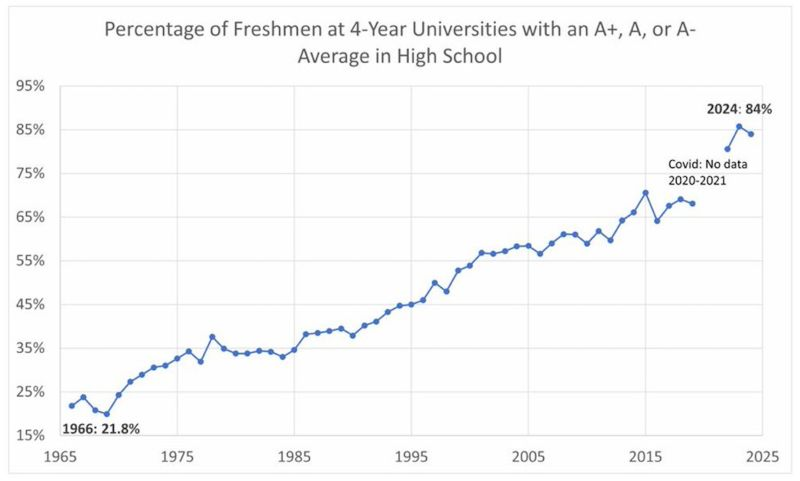
With grades becoming increasingly inflated (see graph below), colleges are looking increasingly for genuine proof of capability.
What Mastery Actually Means
Most school assessments test awareness or recall.
- Can you remember the formula?
- Can you identify the right answer on a multiple choice test?
- Can you follow the procedure the teacher showed you?
At Forge, we think of these on a continuum with mastery being the goal and being demonstrable through application and/or teaching.
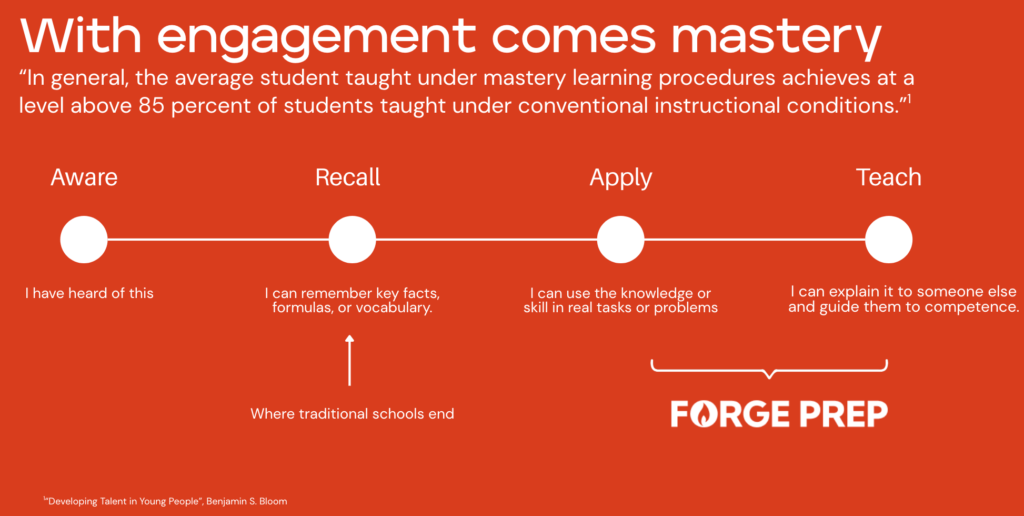
We define four levels of understanding:
- Awareness: I’ve heard of this
- Recall: I can remember key facts and formulas
- Application: I can use this to solve real problems
- Teaching: I can guide someone else to competence
Most schools stop at recall. We require application or teaching.
Abigail’s Diabetes Campaign demonstrates application.
She didn’t memorize formulas. She applied mathematical reasoning to solve an authentic problem.
Teaching means explaining the concept to others until they achieve competence. This is the highest form of understanding. When students can teach a peer to competency, they’ve learned the concept at a level no multiple-choice test can measure. Teaching also means Forge has a more collaborative culture and less of a zero-sum “you must lose for me to win” culture.
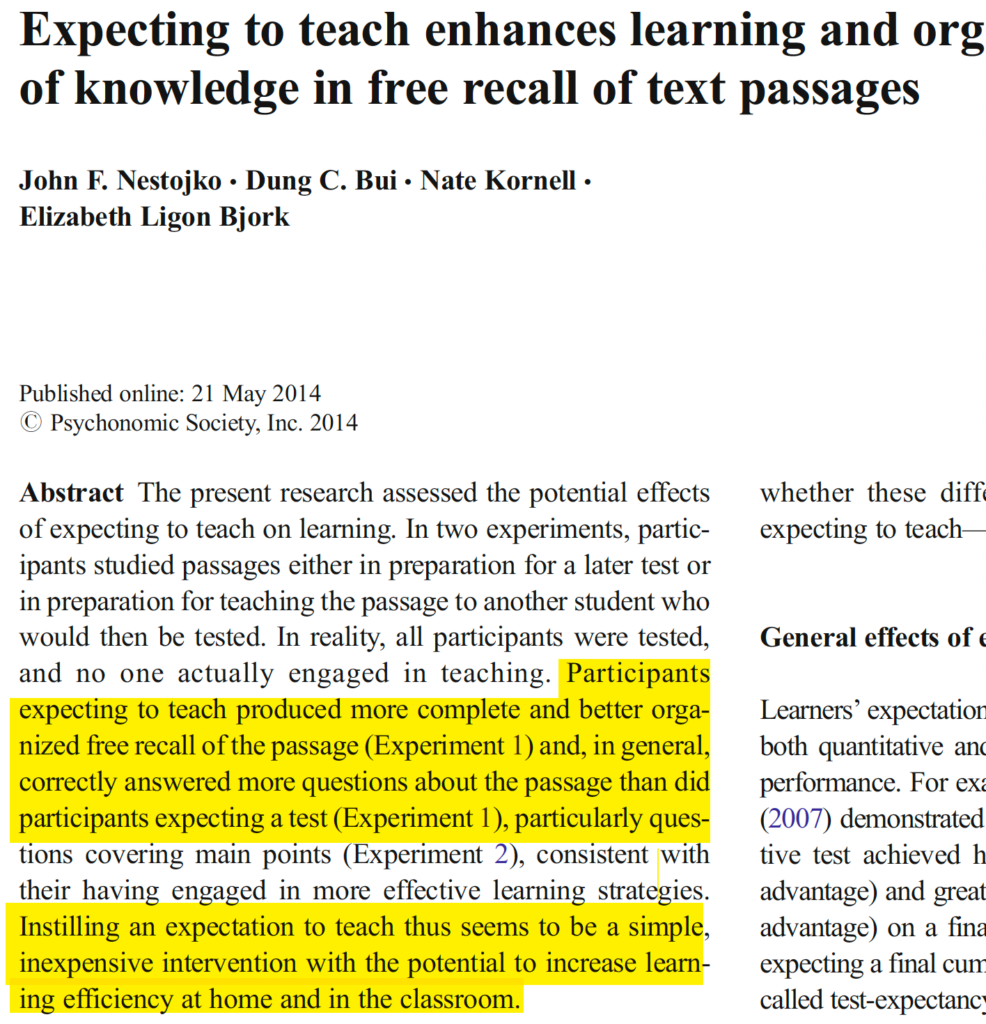
And research confirms this: students who prepare to teach process information more effectively than students preparing for a test. They focus on main points, organize information coherently, and retain more. Teaching isn’t just proof of mastery. Preparing to teach actually creates deeper mastery.
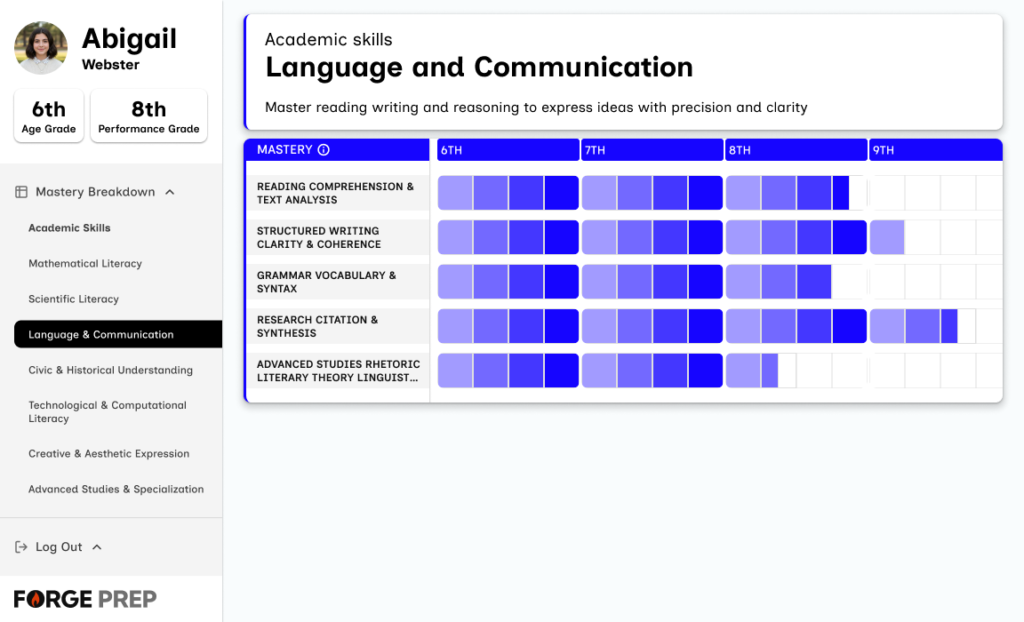
The colored squares on the Proof Transcript light up only when students demonstrate they can apply the skill independently or teach it effectively. That’s why each square links to evidence: a project, a presentation, a peer teaching session. Proof, not points.
Three Things Traditional Systems Cannot Do
1. Show actual capability
Every colored square represents demonstrated mastery of a specific skill. Not “tried hard.” Not “got partial credit”, not “participated a lot in class”.
When a student lights up “Persuasive Communication,” you click “View Artifact” and see their presentation to a small business or their pitch to city council. You don’t see a grade or a teacher’s description of their work. You see the actual work.
2. Eliminate artificial ceilings and floors
Notice Abigail’s transcript shows her age grade (6th) and performance grade (8th). She’s working two years ahead in multiple domains.
Traditional systems punish this. You have to move with the herd.
You can’t get more than 100% in 6th grade math, even if you’re ready for algebra.
Research is clear: Students benefit from learning at their actual readiness level, not their age level.
Yet traditional report cards make this invisible.
A 6th grader working at 8th grade level just gets an A, same as the student who memorized enough to do well enough on the test.
All signal gets lost.
Equally important: there’s no “failing.” There’s “demonstrated mastery” and “not yet.” Students who need more time aren’t branded with an F that haunts their transcript or worse makes them say things like “I’m not a math person” or “I hate ELA”.
They’re simply still working toward mastery. What matters is the trajectory of constant, consistent progress.
Progress, not perfection.
3. Provide real-time, actionable information
Traditional report cards arrive quarterly. A retrospective of what happened months ago. By the time you see “struggling in science,” your child has already spent 10 weeks lost.
The Proof Transcript updates continuously. Parents see what their child is currently working on, what they’ve recently mastered, what’s next in their learning progression. Parents can see what their child is working on which is detailed in their Growth Plan and access ‘At Homes’. At Homes are activities designed for families to practice these skills together if they have the time and desire to do so.
A meta-analysis of parental involvement research found that specific, skill-focused engagement improves student outcomes significantly more than general “how was school today” conversations.
Power Skills: The Part Traditional Transcripts Ignore Completely
The Proof Transcript measures progress on 2 distinct skill types:
- Academic skills – what students know
- Power skills – how students think and act
Look at the below Gold skills for Abigail. Communication & Collaboration. Cognitive & Analytical Thinking
These aren’t academic courses.
These are the skills that actually matter in life and work.
And schools don’t consciously help students develop these.
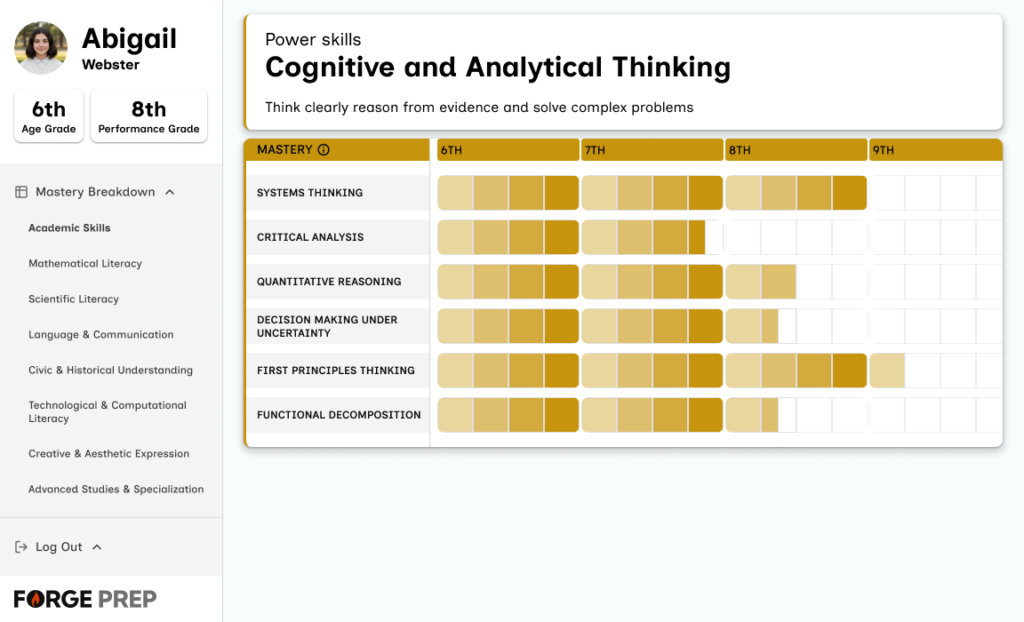
These are skills that answer questions like:
- Can your child think in systems?
- Make decisions under uncertainty?
- Present ideas persuasively?
- Work across functional teams?
Traditional transcripts have no space for this. They record that your child sat through “US History” and “Biology II” but capture nothing about whether they can actually think, create, persuade or collaborate.
In an AI world, these are the human skills that will be the most in demand.
The Proof Transcript treats these as first-class competencies, tracked with the same rigor as academic skills. When colleges say they want to see “leadership” or “collaboration,” they don’t want a list of club memberships.
They want proof.
This transcript provides it.
Standards-Mapped but Not Standards-Capped
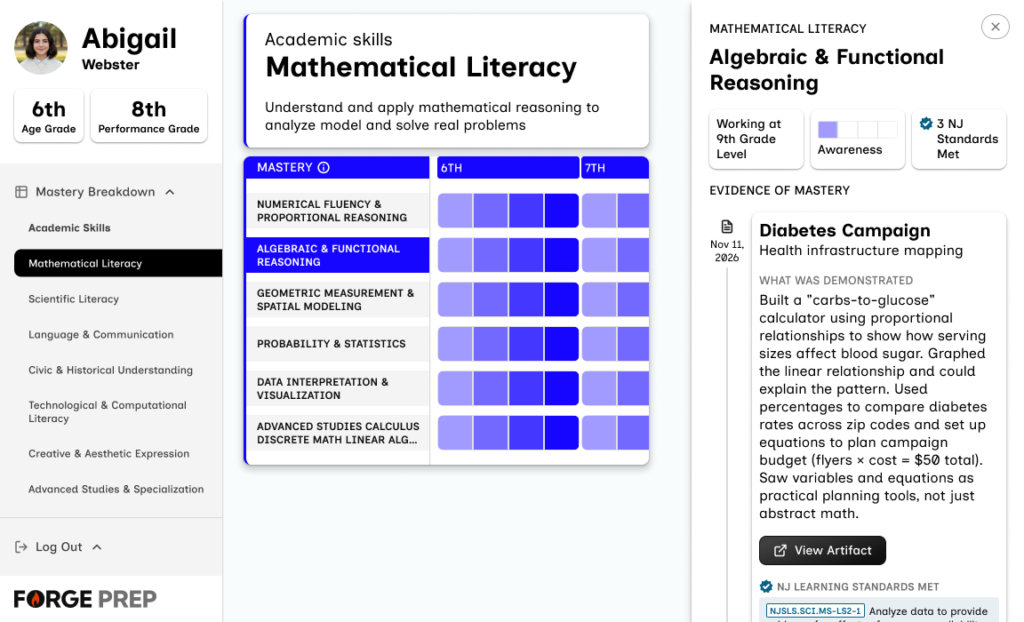
That small text in the lower right corner reading “3 NJ Standards Met” does important work.
The Proof Transcript maps to NJ Learning Standards. This ensures that we can verify your child met state requirements.
But meeting standards is the floor, not the ceiling.
And even meeting that floor requires genuine mastery: not awareness, not recall, but application or teaching competence. Traditional systems let students pass by memorizing and regurgitating.
The Proof Transcript requires they actually understand.
Traditional systems teach to standards, test for standards, and stop. The Proof Transcript shows when students exceed them, sometimes by years.
Progress Over Perfection
Traditional grading rewards perfection. Or more accurately, rewards the appearance of perfection. Don’t take the challenging course if it might lower your GPA. Don’t attempt the ambitious project if you’re not sure you’ll nail it.
The system punishes risk.
The Proof Transcript rewards progress. Attempt the hard thing. You won’t be penalized for “not yet.” You’ll just keep working until you demonstrate mastery. This changes student behavior in profound ways.
Research on mastery learning shows that given adequate time and support, most students can reach high levels of achievement. Traditional systems impose artificial time constraints (the semester ends, ready or not) then rank students by who learned fastest.
The Proof Transcript asks: can you demonstrate this capability? Take the time you need, whether fast or slow.
What This Means for Your Child’s School
If you’re reading this and thinking “why doesn’t my child’s school do this,” you’re asking the right question.
The technology exists. The research supports it. The only barrier is institutional inertia. Schools are stuck using a measurement system designed in the 1900s because that’s what schools have always done and because it’s easier for adults to give a grade than coach and guide to true understanding and mastery.
Your child will enter a workforce that values demonstrated capability, not credential accumulation as we’re quickly moving from a parchment economy to a Proof Economy. The Proof Transcript prepares them for that reality.
We’re incredibly excited to be building a school where students see that progress matters more than perfection. They spend thousands of hours in school, and they deserve a system that celebrates progress, not one that punishes imperfection. They deserve proof of what they can do, not letters that obscure their capabilities. This is what that system looks like.
About Us
Forge Prep is reimagining education for grades 5-12. We equip students to be explorers, builders, and leaders. Our students learn by doing: starting, running, and even acquiring real businesses while developing critical thinking, resilience, and leadership skills. Our mission is simple: build a generation of remarkable students who solve problems and shape the future.
Recommended
- Proof Over Perfection: What Should Replace Your Child's Report Card
- Entrepreneuring Is the Best Natural Lab for LearningEntrepreneuring is a system of thinking and doing that anyone can develop.
- Bread, Circuses and EducationMost of what passes for educational progress is actually a sophisticated form of distraction.
- Announcing the Forge Fellowship: Fueling the young & ambitious$1000 of possibility
